

By Elena Alyavina and Carlos Lopez-Galviz,
“How many different alternative uses can you imagine for a parking space?” read the opening question of the first Creative Sprint, run by the INFUZE team and Ahead Partnership at Carr Manor Community School in Moortown, Leeds. In just three minutes, nine groups of four to six Year 10 students came up with 132 unique ideas of what a mundane parking space could become in the future. A couple of weeks later, we tried the same exercise with our Partners Board. Made of sterner stuff, two dozen transport professionals came up with 112 unique ideas!
This is not a question of who did better. What we found interesting was that the imaginative range of both adolescents and adults in Leeds might be more closely aligned than we thought. Alternative transport infrastructure, commercial units, green, social, fun and artsy spaces, ecologically oriented solutions, and pro-social initiatives such as affordable housing and clothes donation points, and many more made up this growing bank of desired alternatives.

Critical agents of change
The number and range of ideas for a regular car park, elicited by a brief brainstorming exercise, point to the value of engaging with children and young adults when thinking about the future of places. Children are ‘critical agents of change’. Today’s generation of children place increasing importance on pro-environmentalism. Given the right agency, they can influence their social circles, including parents, to act more sustainably. As shown in the above word cloud, they are capable of generating credible ideas, and have the capacity to make responsible decisions that can benefit not just their own development as responsible citizens but also the development of communities actively influencing their localities.
Yet, young adults’ and children’s meaningful participation and inclusion of their rights in policy design are far from common practice. Because of this, places and systems are often developed around adult needs and purposes and around adults’ perceptions of children’s needs (not necessarily reflective of reality). This arrangement reinforces structural inequality, vulnerability, and marginalisation in the living spaces we share. Transport systems, if not designed to be inclusive of younger citizens’ needs, may limit young people’s autonomy and independence, promote reliance on lifts from parents, and strengthen their beliefs in the necessity of owning a car in the future. At the same time, the presence of children in the household, in countries like the UK, Germany and Australia, is one of the core drivers of so-called forced car ownership. This can persists even after children grow up and leave the parental household.
A collaborative approach
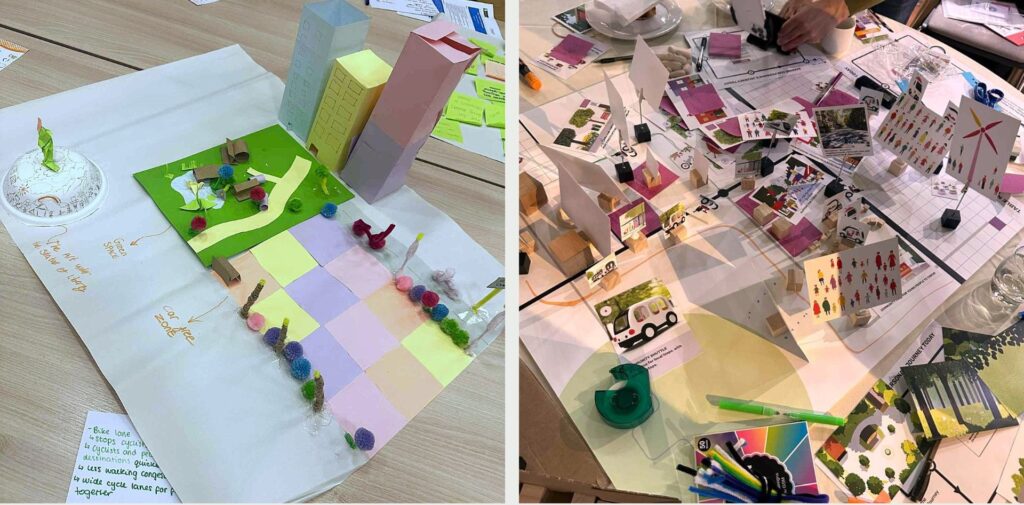
These are some of the reasons why INFUZE takes a different approach, collaborating with a variety of citizen groups. So far, we have engaged with a selection of Year 10 students at four schools – Carr Manor Community School, Pudsey Grammar School, Leeds West Academy, and Leeds East Academy. Aside from imagining alternative uses for a parking space, students generated their own specific projects by asking a “How might we…?” question and prototyping place and transport alternatives as a response to their questions.
Prior to the Creative Sprints, the INFUZE team also hosted two Creative Assemblies at Leeds City Museum. Participants were chosen from among the 500 adults who responded to our Call to Action to reimagine how we get around Leeds together. During the assemblies we explored the shared philosophies and values, the feelings, risks and opportunities that not owning a car may create for future Leeds. Grouped around themed tables, each with its own mission, we reimagined journeys, including those that are most difficult to complete without a car. We paid close attention to transport challenges and opportunities, and how these might impact on the future shape of, and amenities provided at, particular places like mobility hubs, high streets, hospitals, and pedestrianised neighbourhoods.
What we’re learning
Whilst the analytical work of these activities is still ongoing, we already see a lot of similarities and differences in how young people and adults in Leeds see the future of their city. We learned that both groups view inclusion, fairness and affordability as important to help shape transport provision. They both feel that health and the environment should be considered as part of the goals of future systems. Both groups also think that integrated transport and mobility should take into consideration independence and autonomy as well as safety and the quietness and serenity of streets, roads, and infrastructure. Whilst their goals are closely aligned, it’s in the how these goals might be achieved where we can find some divergence.
Inclusion and safety of children and youth was one of the prominent themes coming out of the responses to our Call to Action. However, this was seen as the “segregation” of children from “dangerous” activities and other adults by, for example, designing new places and spaces for the exclusive use of children and youth such as playgrounds and venues for youth groups. Segregation could also involve re-locating after-school activities, possibly back to schools, so that children, especially younger ones, could get there safely, ideally within the vicinity of their homes, giving parents the chance to embrace their own “independence and autonomy” through the day.
Why young voices matter
By contrast, the Year 10 students involved in the Creative Sprints sought integration rather than segregation. The desire to be accepted as members of the wider community could be seen in one group of students’ redesign of New Pudsey bus station. The design featured a football pitch on the station’s rooftop where children could socialise not just with peers but also with other station users. It also included a flexible green space with a busking stage, a picnic spot, and a children’s playground. The train platform, in turn, featured a play area for the little passengers, while a new pedestrianised high street was colourful, clean, and well-lit, making children (and everyone) feel welcomed and safe, including during dark hours.
What we notice, overall, is that young adults envision spaces and transport options that are inclusive to all, regardless of age or ability. Their ideas highlight where integration rather than segregation might occur, providing space and solutions that combine creativity with flair and openness. If a street or a bus station is designed in a way where the young and most vulnerable feel safe, wouldn’t we all feel safe as a result? Isn’t that how we all become winners?
Visions for a better future
INFUZE is creating space to think differently about the multiple dimensions and meanings involved in envisioning futures with reduced car ownership. The Creative Sprints and Creative Assemblies are our starting points. These events are helping us test how best to listen and to understand what people care about when considering a future which may be different from what we’re used to. They also help the INFUZE team reflect on how to combine what we learn through this collaborative process with tools and methods used in transport planning.
Our work at INFUZE has been strongly influenced by, among others, Monika Büscher and Greg Marsden’s work on Changing Mobilities. An important part of what INFUZE seeks to achieve is generating alternatives for ‘better institutionalised habits of thinking and acting differently, collectively using and inventing processes to bootstrap response-ability’. These habits of thinking and acts of difference are essential to face the scale of the climate emergency in the UK and worldwide. They are also essential to help shape a better future Leeds.
Selected further reading
- Biggs, S., & Carr, A. (2015). Age- and Child-Friendly Cities and the Promise of Intergenerational Space, Journal of Social Work Practice, 29(1), 99–112. https://doi.org/10.1080/02650533.2014.993942
- Büscher, M. and G. Marsden, Changing Mobilities (Routledge: forthcoming).
- Cordero-Vinueza, V. et al (2023), Making child-friendly cities: A socio-spatial literature review, Cities 137, 104248, https://doi.org/10.1016/j.cities.2023.104248
- Mansfield, R. G., Batagol, B., & Raven, R. (2021). “Critical Agents of Change?”: Opportunities and Limits to Children’s Participation in Urban Planning. Journal of Planning Literature, 36(2), 170-186. https://doi.org/10.1177/0885412220988645.