
By Vanessa Ternes
In my research, I refer to people as “experts on their own lives”. I believe that people’s views and lived experiences are a rich source of data. Studying these gives us policy-relevant insights into how different people perceive their lives and the world around them.
Research confirms that perceptions matter: We know that a policy is more successful if it’s supported by the public. Fairness is an important value to people, so policies that are perceived to be fair tend to receive more public support. More generally, people’s perceptions influence their attitudes and their actions. However, we know very little about what the public actually perceives to be fair.
Therefore, I sought to understand how the public thinks about the fairness of decarbonisation politics. My case study was the Zero Emission Vehicle Mandate, which legislates that all new cars and vans in the UK will need to be zero emission in the future. If successful, this policy can make a large contribution towards reducing transport emissions. However, ZEVs also risk exacerbating existing inequalities within transport.
Finding out what really matters
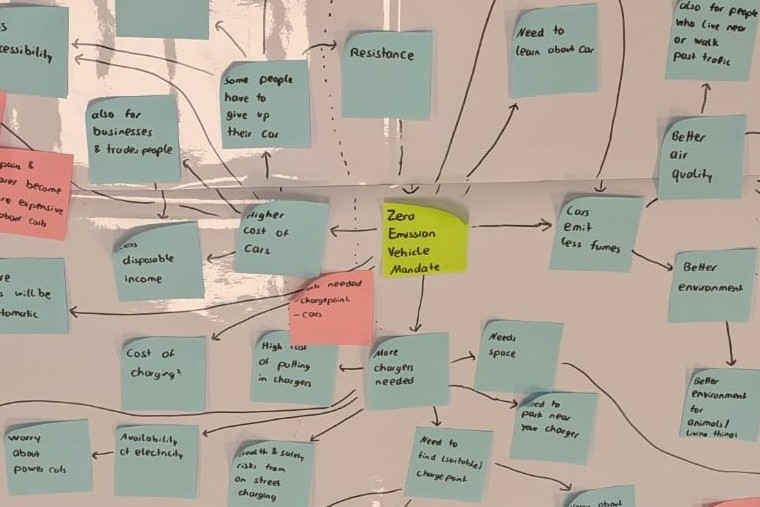
To study public views, I held ten focus groups with members of the public in several neighbourhoods across Leeds. Here, I turned my philosophy of “participants as experts on their own lives” into action. Two things were crucial to the success of this approach:
- Removing barriers to participation. I expected that many people had never taken part in a focus group before, therefore I made participating in the project as inviting and un-scary as possible. Starting with the invites, I used everyday language and made it clear that no expert knowledge was needed. Focus groups took place in local community centres, reducing travel time for participants. Participants were able to share their thoughts through written notes as well as group discussion, catering to different needs and preferences. I made sure to guide participants through all steps in plain language, avoiding any technical jargon.
- Curiosity and training. Every insight or view that participants shared formed part of my research data, therefore I welcomed all contributions equally. Prior to running the focus groups I received in-depth facilitation training. This prepared me to create space for participants, to listen intently and capture participant input without judgement.
Public perception of the ZEV Mandate
The approach I took helped uncover deeper insights into how participants view the ZEV Mandate and its fairness implications. I will briefly outline two insights here. You can find more on these in my recently published paper
- Privilege matters: Participants described Zero Emission Vehicles as only for “middle class” or “rich” people. They felt that it requires financial privilege to purchase a ZEV. Once the ZEV is used, the driving costs are lower resulting in yet more financial benefits for the owners. However, those unable to purchase a ZEV won’t have access to these lower driving costs. Or, as one participant put it, “It’s fair once you’re in it”. This perception matters for policy success: If people feel that the policy is only aimed at rich people, and they don’t view themselves as rich, they’ll never even get to the point of thinking through whether a ZEV would work for them.
- Buying a ZEV isn’t the only option: The ZEV Mandate policy texts assume that people will in the future buy ZEVs instead of conventional vehicles, effectively describing business as usual with the only difference being how cars are powered. However, the focus groups revealed that the public sees a wider range of possible responses to the ZEV Mandate. Many said that they would keep their older cars running for longer, which would require continued fuel and maintenance provisions for petrol vehicles. Others said that they’d consider giving up a car to use public transport instead, which would require more investments into a reliable public transport system. Policy makers thus need to understand how people will respond to the policy.
This research has revealed the nuanced and detailed perceptions of the public. It shows the need for broad engagement to understand public views and to tailor a policy accordingly. Otherwise, there remains a real risk that policies are perceived as unfair, and are thus less successful.
Read the full paper here: “It’s fair once you’re in it” – Comparing public and government perceptions on Zero Emission Vehicle policy